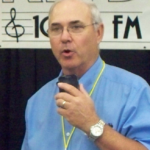
Former Arkansas Supreme Court Justice Darrell David Hickman, a Searcy native whose constitutional rulings helped reshape Arkansas law, died Thursday, August 20, in his hometown.

He was 91.
Hickman was diagnosed with esophageal cancer in early summer and underwent 1 round of chemotherapy.
Hickman spent nearly 22 years serving Arkansas as a trial-court judge and justice of the Arkansas Supreme Court.
Throughout his judicial career, Hickman believed courts should strictly enforce the state and federal constitutions, even when provisions were considered outdated or overly restrictive.
He believed lawmakers and voters should amend the Arkansas Constitution instead of allowing government officials to ignore or work around its language.
Several of Hickman’s decisions eventually helped lead to constitutional amendments approved by Arkansas voters during the 1980s and 1990s.
Hickman was born February 6, 1935, in Searcy to Paul Hickman and Mildred Jackson Hickman.
His father lost his railroad job during the Great Depression and worked several jobs before becoming a truck driver. His mother operated a beauty parlor.
Hickman attended Harding College, now Harding University, in Searcy for 2 1/2 years before transferring to the University of Arkansas in Fayetteville.
He spent 3 summers scaling logs at a U.S. Forest Service lumber camp near Fresno, California.
Hickman earned his law degree from the University of Arkansas in 1958.
Following graduation, Hickman received a United States Navy commission and spent 6 years in the service.
He served 2 years as legal officer aboard the aircraft carrier USS Constellation.
Hickman returned to Searcy in 1964, opened a law practice and became a deputy prosecuting attorney.
He entered politics in 1966 with an unsuccessful campaign for the Arkansas House of Representatives in a district covering White and Lonoke counties.
Hickman later worked for Democratic gubernatorial candidate Ted Boswell in 1968 and Dale Bumpers’ successful campaign for governor in 1970.
He entered the judicial arena in 1972 by challenging Chancellor Kay L. Matthews of Little Rock.
Hickman carried Pulaski, White and Lonoke counties and won the election. He was never defeated in another race.
As a chancery judge, Hickman developed a reputation for strictly enforcing the language of the 1874 Arkansas Constitution.
He ruled that expense accounts for county officials were unconstitutional and stopped Pulaski County from working around the Constitution’s $5,000 compensation limit for elected officials.
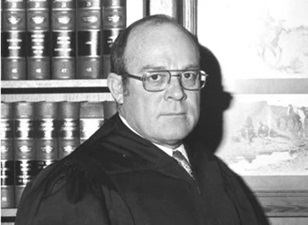
The Arkansas Supreme Court upheld Hickman’s ruling. Arkansas voters later approved an amendment modernizing county government and compensation.
Hickman also ruled that revenue bonds proposed to finance an office development on the Arkansas State Capitol grounds were unconstitutional.
In 1975, Hickman blocked a proposed convention intended to rewrite much of the state Constitution.
He ruled the convention legislation was invalid because some delegates were appointed instead of elected and because lawmakers had placed certain constitutional provisions beyond the delegates’ authority.
The Arkansas Supreme Court upheld Hickman’s decision by a 4–3 vote on the morning the convention was scheduled to begin.
As chancellor, Hickman helped draft legislation reorganizing Arkansas judicial circuits, aligning circuit and chancery court boundaries and allowing judges to hear both law and equity cases.
The legislation streamlined the Arkansas court system and created additional judgeships.
Hickman was elected to the Arkansas Supreme Court in 1976 after Justice Lyle Brown retired.
He defeated a circuit judge from El Dorado and a former state representative from Little Rock to complete Brown’s term.
Hickman was later reelected to a full term.
His election made him the 1st person from White County elected to statewide office since Reconstruction.
In 1977, Hickman hired Joyce Williams Warren as the Arkansas Supreme Court’s 1st Black law clerk.
Warren later became Arkansas’ 1st Black female judge and the 1st Black person elected to an Arkansas state-level trial-court judgeship. She retired from the bench in 2020.
Hickman continued opposing government revenue bonds while serving on the Supreme Court.
In 1986, the court reversed decades of precedent and ruled in a Hot Springs case that revenue bonds required voter approval.
Financial institutions and bond attorneys responded by developing Amendment 65, which Arkansas voters approved to legalize revenue bonds.
In 1982, Hickman helped remove a proposed constitutional amendment from the ballot because its approximately 10,000-word ballot title was considered too confusing.
Hickman said it took him 5 minutes to read the ballot title, while voters were allowed only 3 minutes inside the voting booth.
That ruling became an important standard for reviewing whether proposed ballot measures were confusing or misleading.
Hickman also argued that the Arkansas Supreme Court lacked constitutional authority to discipline or remove judges.
He directed the drafting of Amendment 66, which established the Arkansas Judicial Discipline and Disability Commission.
Arkansas voters approved the amendment in 1988.
Hickman retired from the Arkansas Supreme Court in 1990 after serving as the court’s senior justice for 4 years.
He traveled extensively through the western United States and Canada, including taking long motorcycle trips, before returning to White County.
Acting Governor Jim Guy Tucker appointed Hickman to a White County Circuit Court vacancy in 1992.
Governor Mike Huckabee appointed him to another circuit-court vacancy in 2000. Hickman served in that position for 2 years.
Hickman requested that no funeral be held. His family plans a private graveside service at a later time.
He is survived by his wife of 54 years, Kerry Hickman of Searcy; his son, David Hickman and wife Mary of Ben Wheeler, Texas; his adopted daughter, Torrie Cook and husband Mitchell of Searcy; and granddaughters Emily McFadden and husband Conner of Lindale, Texas, and Corinne Hickman of Ben Wheeler.
His daughter, Dana Hickman Wolfe, preceded him in death.
Hickman leaves a lasting legacy of military service, judicial independence and dedication to the Arkansas Constitution.
Career information was confirmed through the Encyclopedia of Arkansas:
https://encyclopediaofarkansas.net/entries/darrell-david-hickman-8992/