Burn bans now cover nearly the entire state as Arkansas experiences worsening drought conditions and a high statewide wildfire risk.
As of Sunday, September 6, 2026, Independence and Izard counties had been declared local disaster areas because of extremely hot and dry conditions.
Independence County Judge Kevin Jeffery issued the county’s declaration Saturday, September 5. Officials said the continuing drought threatens residents, property and agricultural operations.
Independence County joined neighboring Izard County, where County Judge Eric Smith previously issued a local disaster declaration because of severe drought conditions.
The declarations allow county officials to coordinate emergency operations and establish a formal record of the worsening conditions. However, a local disaster declaration does not automatically provide state or federal emergency funding.
Burn Ban Counties (72)
Arkansas, Ashley, Baxter, Benton, Boone, Bradley, Calhoun, Carroll, Chicot, Clark, Clay, Cleburne, Cleveland, Columbia, Conway, Craighead, Crawford, Crittenden, Cross, Dallas, Desha, Drew, Franklin, Fulton, Garland, Grant, Greene, Hempstead, Hot Spring, Howard, Independence, Izard, Jackson, Jefferson, Johnson, Lafayette, Lawrence, Lee, Lincoln, Little River, Logan, Madison, Marion, Miller, Mississippi, Monroe, Montgomery, Nevada, Newton, Ouachita, Perry, Phillips, Pike, Poinsett, Polk, Pope, Prairie, Pulaski, Randolph, Saint Francis, Saline, Scott, Searcy, Sebastian, Sevier, Sharp, Stone, Union, Washington, White, Woodruff, Yell
High Risk Counties (75)
Arkansas, Ashley, Baxter, Benton, Boone, Bradley, Calhoun, Carroll, Chicot, Clark, Clay, Cleburne, Cleveland, Columbia, Conway, Craighead, Crawford, Crittenden, Cross, Dallas, Desha, Drew, Faulkner, Franklin, Fulton, Garland, Grant, Greene, Hempstead, Hot Spring, Howard, Independence, Izard, Jackson, Jefferson, Johnson, Lafayette, Lawrence, Lee, Lincoln, Little River, Logan, Lonoke, Madison, Marion, Miller, Mississippi, Monroe, Montgomery, Nevada, Newton, Ouachita, Perry, Phillips, Pike, Poinsett, Polk, Pope, Prairie, Pulaski, Randolph, Saint Francis, Saline, Scott, Searcy, Sebastian, Sevier, Sharp, Stone, Union, Van Buren, Washington, White, Woodruff, Yell
Risk Level Definitions
Risk levels are determined by fuel conditions, drought status, and long-term weather forecasts. They are categorized by how easily fires can start and how hard they are to contain. The risk level definitions are:
- Low: Fuels do not ignite easily. Weather conditions will lead to slow spread and relatively easy to control fires.
- Moderate: Fire can start from accidental causes. May not become serious, but caution should be taken.
- High: Fires ignite easily and spread quickly. Unattended brush fires and campfires are likely to escape. Fires may become serious if not attacked early.
- Extreme: Fires start quickly, spread furiously, and burn intensely. Every fire started has the potential to become large. Expect extreme, erratic behavior.
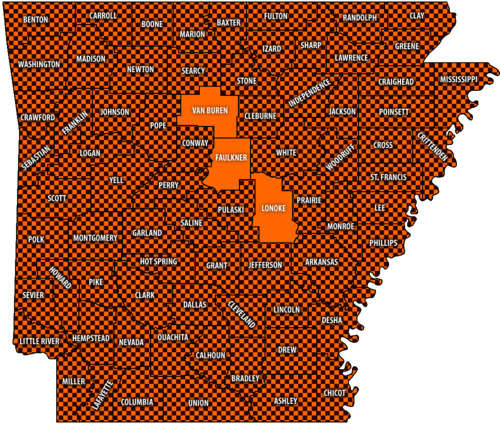
According to the Arkansas Forestry Division’s official map, 72 of Arkansas’ 75 counties were under burn bans as of 7:27 a.m. Sunday, September 6, 2026.
All 75 Arkansas counties were classified as having a high risk of wildfires.
Under the Forestry Division’s definition, high wildfire danger means fires can ignite easily and spread quickly. Unattended brush fires and campfires are likely to escape, and fires could become serious if they are not attacked early.
ONLY 3 COUNTIES OUTSIDE BURN BANS
Faulkner, Lonoke and Van Buren counties were the only Arkansas counties not listed under burn bans Sunday morning.
Although those 3 counties were not under county-issued burn bans, each remained classified as having a high wildfire risk.
Burn bans are issued and lifted by county judges. Restrictions can change quickly depending on rainfall, drought conditions, available fuel and wildfire activity.
72 ARKANSAS COUNTIES UNDER BURN BANS
The Arkansas Forestry Division listed the following counties under burn bans:
Arkansas, Ashley, Baxter, Benton, Boone, Bradley, Calhoun, Carroll, Chicot, Clark, Clay, Cleburne, Cleveland, Columbia, Conway, Craighead, Crawford, Crittenden, Cross, Dallas, Desha, Drew, Franklin, Fulton, Garland, Grant, Greene, Hempstead, Hot Spring, Howard, Independence, Izard, Jackson, Jefferson, Johnson, Lafayette, Lawrence, Lee, Lincoln, Little River, Logan, Madison, Marion, Miller, Mississippi, Monroe, Montgomery, Nevada, Newton, Ouachita, Perry, Phillips, Pike, Poinsett, Polk, Pope, Prairie, Pulaski, Randolph, Saint Francis, Saline, Scott, Searcy, Sebastian, Sevier, Sharp, Stone, Union, Washington, White, Woodruff and Yell counties.
2 COUNTIES DECLARE LOCAL DROUGHT DISASTERS
Independence and Izard counties have also issued local disaster declarations because of extreme heat, worsening drought and dangerously dry conditions.
Independence County Judge Kevin Jeffery issued the county’s declaration Saturday, September 5. Officials said the ongoing drought threatens residents, property and agricultural operations.
Independence County joined neighboring Izard County, where County Judge Eric Smith previously issued a local disaster declaration because of severe drought conditions.
The local declarations provide a framework for coordinating emergency operations and establish an official record of the worsening conditions.
However, the declarations do not automatically provide state or federal emergency funding.
USDA DISASTER DESIGNATION COVERS ARKANSAS
The local declarations in Independence and Izard counties are separate from the U.S. Department of Agriculture’s agricultural disaster designation.
The USDA previously designated 67 Arkansas counties as primary natural-disaster areas because of drought.
The remaining 8 counties—Crawford, Franklin, Lafayette, Logan, Madison, Miller, Nevada and Sebastian—were listed as eligible contiguous counties.
That means qualifying agricultural producers across all 75 Arkansas counties may be eligible to apply for certain USDA disaster assistance, including emergency loans.
The application deadline associated with the USDA emergency-loan designation is December 7, 2026.
ARKANSANS URGED TO USE EXTREME CAUTION
Residents should avoid outdoor burning and use extreme caution with anything capable of creating a spark.
Potential fire sources include vehicles parked over dry grass, dragging trailer chains, lawn equipment, welding tools, farm machinery, cigarettes, campfires and outdoor grills.
Anyone who spots a wildfire should immediately call 911 or report it to Arkansas Forestry Division Dispatch at 1-800-468-8834.
Prescribed fires should be reported before ignition at 1-800-830-8015.
BOTTOM LINE
As of Sunday morning, 72 of Arkansas’ 75 counties were under burn bans, all 75 counties faced high wildfire danger and Independence and Izard counties had declared local drought disasters.
Faulkner, Lonoke and Van Buren counties were the only counties not listed under burn bans, but all 3 remained at high risk for wildfires.
Residents should check the official Arkansas Forestry Division map before conducting any outdoor burning:
https://mip.agri.arkansas.gov/agtools/Forestry/Fire_Info?do%3AshowBurnBans=