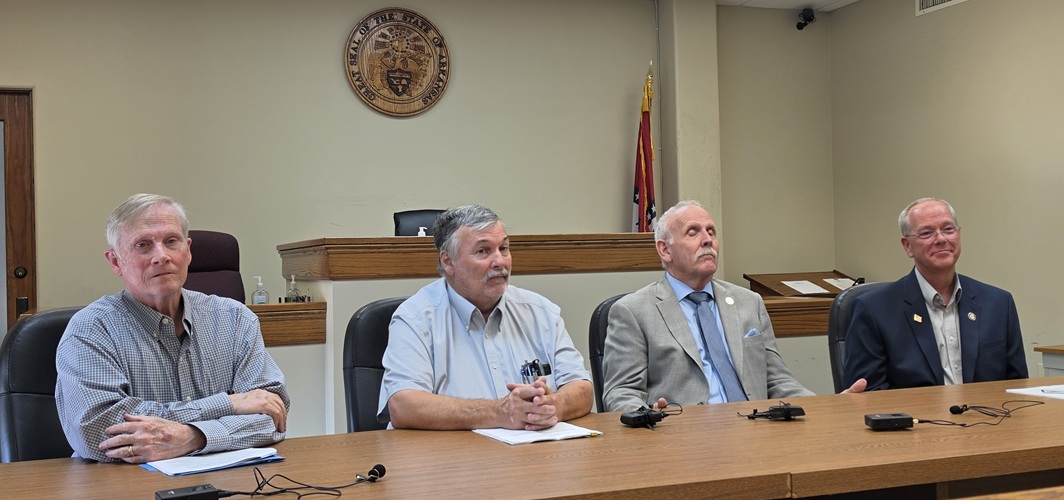
MORRILTON, Ark. — Local officials gathered for a press conference Thursday, August 6, 2026, at the Conway County Courthouse to discuss a federal appeals court ruling reinstating Arkansas’ oil and gas royalty law and what the decision could mean for mineral rights owners throughout the Fayetteville Shale.
Van Buren County Judge Dale James and Conway County Judge Jimmy Hart were among those discussing the significance of the ruling and its potential impact on Arkansas landowners receiving oil and natural gas royalties.
A federal appeals court has reinstated Arkansas’ oil and gas royalty law, clearing the way for enforcement of legislation governing how post-production expenses are handled when calculating royalty payments to mineral rights owners in the Fayetteville Shale.
The 8th U.S. Circuit Court of Appeals reversed an earlier decision by U.S. District Judge D.P. Marshall, who had blocked enforcement of Act 1024 of 2025 against mineral lease agreements signed before the law took effect on August 5, 2025.
The three-judge appellate panel concluded that Act 1024 does not create new legal obligations but instead clarifies existing Arkansas law governing royalty payments.
Judge Lavenski R. Smith of Little Rock, writing for the unanimous panel, said Arkansas law had allowed certain post-production deductions but had not clearly established the circumstances under which those deductions could be taken.
According to the appellate opinion, the Arkansas Legislature addressed that uncertainty through Act 1024 by clarifying that when a mineral interest is covered by a lease, deductions must be consistent with the terms of that lease.
“The 1/8 royalty was always required to be paid according to the lease,” Smith wrote.
Senior Judge Ralph Erickson and Judge Jonathan A. Kobes joined Smith in the 17-page opinion.
Local Judges React at Conway County Courthouse
Thursday’s press conference brought the federal court decision home to an area at the center of the Fayetteville Shale, where mineral royalties have provided income to thousands of Arkansas property owners.
Van Buren County Judge Dale James called the ruling a significant victory for royalty owners.
“This is a huge day for the citizens of Van Buren County and all the royalty owners of the Fayetteville Shale,” James said.
James explained that royalty owners include Arkansans who have leased their mineral interests to natural gas companies.
“Common sense prevailed in Arkansas,” James said. “What your lease states that you will receive is what you should receive, as upheld by the 8th Circuit Court.”
James said the decision means mineral owners should receive what was agreed to in their leases.
“You’re not going to get anything less going forward than what you signed for and what is filed in the court system at courthouses across the state,” James said.
Conway County Judge Jimmy Hart also characterized the appeals court decision as an important victory for ordinary Arkansas property owners.
“This is a major win for the little folks in the state of Arkansas, the salt of the earth, the grassroots people that understand fair play and understand property ownership and mineral ownership as part of property ownership,” Hart said.
Hart emphasized the importance of honoring the terms of agreements between mineral owners and producers.
“A lease is a contract, and a lease is a lease,” Hart said.
Background of the Dispute
The legal fight centers on Act 1024 of 2025, legislation addressing royalty payments made to Arkansas mineral rights owners.
The law restricts oil and gas operators from deducting certain post-production expenses, including costs associated with gathering, treating and compressing natural gas, before calculating the mandatory 12.5% royalty unless those deductions are permitted under the mineral lease.
Oklahoma City-based Flywheel Energy Production and three other companies challenged the law in June 2025.
The companies argued that the statute was vague, violated provisions of the Arkansas and U.S. constitutions and improperly affected existing contractual rights.
Flywheel sought to continue deducting a proportional share of post-production expenses before royalty payments were made to mineral owners.
Lower Court Decision Reversed
Marshall previously sided with the companies, finding that enforcing Act 1024 against existing leases could increase the cost of operating natural gas wells and potentially cause some wells to be plugged sooner.
The district judge reasoned that reopening plugged wells can be expensive and that some natural gas could consequently remain in the ground.
The 8th Circuit rejected the conclusion that Act 1024 improperly changed existing contractual obligations.
Instead, the appeals court determined that the legislation clarified how Arkansas’ existing royalty requirements interact with individual mineral leases.
Decades-Old Royalty Question
The dispute has roots in Act 272 of 1985, which established a 12.5% royalty requirement involving natural gas produced from integrated drilling units.
However, the earlier law did not clearly define “net proceeds,” contributing to disputes over whether and when producers could subtract post-production expenses before calculating royalty payments.
The appeals court concluded that Act 1024 resolves that uncertainty by making clear that royalty calculations must comply with the provisions of the applicable lease.
Impact Across the Fayetteville Shale
The ruling could have significant consequences throughout the Fayetteville Shale region, where thousands of mineral leases were signed as natural gas development expanded during the early 2000s.
Many leases contain provisions limiting or prohibiting the deduction of certain post-production expenses before royalties are calculated.
Flywheel entered production in the Fayetteville Shale region around 2018 and began deducting certain expenses before calculating the 12.5% royalty, contributing to disputes involving mineral owners and eventually the passage of Act 1024.
With the 8th Circuit’s decision, Act 1024 can again be enforced, giving mineral rights owners additional legal clarity concerning whether post-production expenses may be deducted from their royalty payments.
For James and Hart, Thursday’s message at the Conway County Courthouse was straightforward: mineral owners should receive the royalty payments promised under the leases they signed.